Thursday, 1 July 2021
WELCOME MODERATOR
Thursday, 6 May 2021
CONSTRUCTIONS: FILMING 20TH MARCH
On the 20th March, we filmed a scene which showed the stalker taking pictures of Sarah in her bedroom from across the street where her house was located. We filmed this scene in Walton on Thames and had to wait until it was dark in order to get the right ambiance we were looking for. We experimented with various different shot types that ranged from wide shots, long shots, pans and tracking shots.
Overall, the filming session was successful and we managed to attain the desired shots relatively quickly, despite having to make some alterations. Due to the positioning and angle of the camera outside the house, our originally idea of where to place Sarah inside the house didn't work out as she was too high up to be seen. Instead, we positioned her a floor lower and made sure her seat was close to the window in order to capture her in the shot.
Although our session ran smoothly, we did face some challenges...
Firstly, the available light from the lamp-posts reflected onto the camera lens and there was a glare that featured in the shot. It was not an issue that could go by un-noticed and so we had to change our camera positioning where the glare caused little to no reflection. Secondly, due to our location, we faced the problem of several cars driving past which caused several issues - the sound of the engine ruined the ambiance and the headlights shone into the shot. We overcame this by waiting till cars had passed and the eerie night-time atmosphere returned before filming as it helped to create a more sinister thrill and enhanced the vulnerability of Sarah.
One of our shots was a close up panning shot that followed the camera as the stalker raised it from their chest to their face to take a picture. We had to film this several times as it was hard to make sure the pan was smooth and that we didn't get the face of the stalker in shot. Once we eventually achieved the shot, we felt it was really effective in creating enigma and thrill/suspense.
Monday, 3 May 2021
CASTING: INTERVIEWS
We conducted various interviews with potential actors for the role of the stalker in our production. We asked the following questions in order to gain a better understanding of these actors which led to our final decision for the casting of this character.
Questions:
- Why should we cast you?
- What is your best quality?
- Have you had any previous acting experience?
This interview process allowed us to come to the conclusion that we wanted a female stalker rather than a male as it gave multiple motives for the stalker as well as making our production stand out. We chose Charlotte to be our stalker as she was a well-experienced actor and her current role as Becky, Sarah's best friend fed into our story-line, making it more thrilling as the threat in Sarah's life was actual a lot closer than she thinks.
INTERVIEWS OF FEMALE ACTORS
Thursday, 29 April 2021
REFLECTIONS: PHOTOSHOOT 12TH MARCH
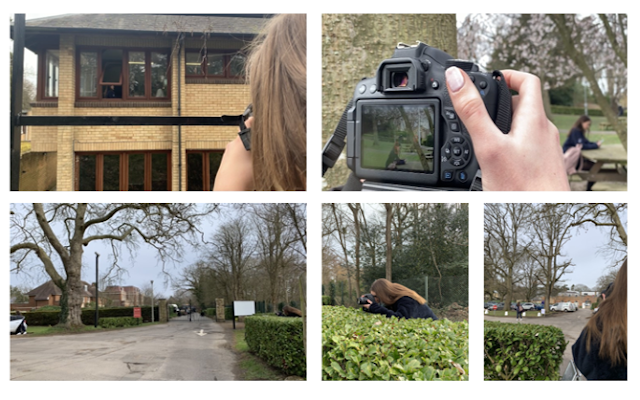
Part of our production includes a table-top sequence which shows the stalker in a dark room, developing and going through various photographs of Sarah that they've taken. In order to film this scene of our production, we needed a series of pictures to act as props. This being said, we organised a session (12.03.21) in which we used a professional high-quality camera to take pictures of our actor playing Sarah. These photographs would've been taken by the stalker in our plot so we had to think about the types of shots we took in order to signify this. Firstly, we took pictures of Sarah in several locations in order to capture the concept that this stalker is following her in all aspects of her life. These locations ranged from sitting on a bench to Sarah sitting in her office as well as on a walk and getting into her car after training. All of our shots had to be long-shots as they were from the POV of the stalker who was taking them behind Sarah's back. To further emphasise the secretive aspect, we thought about camera angles and decided that we needed to capture tree bark in the frame to signify the person taking the shot was hiding behind something and Sarah didn't know they were there.
In addition to this, we also took some shots of the stalker with their camera (concealing their face through camera angles) but in doing this, we came across some challenges. During filming, we noticed that when filming an over-the-shoulder shot, the weather meant we could easily see the reflection of the stalker on the camera screen which is an identity we needed to conceal. To overcome this, we had to adjust our positioning so there was no reflection. Adding to this, we had to adjust the positioning of Sarah when she was sitting in 'her office' as there was a window between her and the camera that did not open fully. This meant that when trying to take a shot, there was a strong glare from the sun shining on the window, making it almost impossible to see Sarah through it. Because the window did not fully open, we had to lower the angle of the camera to get a clearer shot of her.
Thursday, 22 April 2021
HOT SEATING
Planning:
- Stalker- have a voice affect on it and blurr the face- we are having to conceal their identity. Sketchy exchange possibly of money to bribe the stalker to speak about it.
- Ellie- just come in from a run to keep in her character.
- Possibly be in the style of a police interview as if people are being questioned about Sarah's stalking.
- Same quesitons for each- cut from each person's answer.
- What's your name? Where do you work?
- Relationship- last time you saw her? Friendship? How was she?
- Have you noticed anything is wrong with her?
- Does she seem happy? Is there anyone you think that is jealous of her?
- Does she have a partner?
- Do you know Becky and Alice?
- Do you have a bestfriend?
- Do you know anyone who could be jealous of you?
Thursday, 15 April 2021
PLANNING: RISK ASSESSMENT
- Hazard to Health and Safety
- Risk posed and to whom
- Risk Level (H/M/L)
- Control measure to reduce risk
- Further action needed to reduce risk
Transport:
Standing in the street in Walton to get the shot of Jess through the window
from the stalker’s perspective (could have got hit by a car if we were too
focused on shooting). Danger when travelling to destination by car. Moving
vehicles (lorries) in school carpark. Students looking wrong way when crossing
road. Student falling down stairs. Walking across roads. Be cautious when
walking/driving to filming location and be aware of surroundings. Aim to cross
roads at designated pedestrian crossings. Always have a person looking for
incoming cars.
Weather: In the
forest it was slippery due to rain (danger of falling and injuring ourselves).
Danger of getting clothing wet and becoming too cold. Wet camera when filming
outside. Students bring appropriate clothing suitable for all weather and be
cautious when walking on slippery surfaces.
First Aid Issues:
Trips/Falls – could trip over in the dark room. Could come into contact with
harmful chemicals in the dark room. Brambles in woods. Carry a first aid kit at
all times, aim to have a first-aider on stand-by, identify areas of danger
(e.g. brambles or chemicals).
General Public
(e.g. theft or assault): Outside in the dark on the street (danger of potential
assault or kind of incident). Threat of pick-pocking in Walton (not a large
risk as we are not in a crowded location). Students causing incident with
member of public. Students stay in groups when in public spaces (with mobile
phones), do not approach members of public or respond to provoking comments,
students to remain in supervised conditions, do not film late at night, follow
guidance of emergency personnel.
Accommodation
(e.g. risk assessment from centre): No overnight accommodation
Major Public Incident (e.g. terrorism): Not applicable as there is minor chance of a terrorist attack in a small town. In the case of one: Ensure venue has assembly point and pupils know where it is, as well as giving pupils assembly points whilst on public transport. Ensure pupils know the national advice to run if possible and hide if not. Ensure pupils know to always follow police instruction. Issue pupils with printed emergency contact card detailing school landline and school mobile – instruct them to call if they become lost (as well as alerting security official). Ensure trip leader has a school mobile and also contact details for both the school and all pupils + families
|
RISK ASSESSMENT |
HAZARD TO HEALTH AND SAFETY |
RISK POSED AND TO WHOM |
RISK LEVEL (H/M/L) |
CONTROL MEASURE TO REDUCE RISK |
|
Transport |
Incoming cars when we stand in the street to get shots of Jess
through window from stalker’s perspective. And moving vehicles (e.g. lorries) school car park. Traveling in car Crossing roads |
Potential injury through getting hit by a car if we were too focused
on shooting. Danger when travelling to destination by car. Students looking wrong way when crossing road. |
H |
Always have a person looking for incoming cars Students to be made aware of risks. Be cautious when walking/driving to filming location and be aware of
surroundings. Aim to cross roads at designated pedestrian crossings |
|
Weather |
Rain when filming outside making ground slippery and dangerous (especially in forest) Rain making clothes and camera equipment wet |
Rain could cause students to slip and fall – potentially causing
injury. Damage to the camera and risk of students becoming cold. |
M |
Students bring appropriate clothing suitable for all weather and be
cautious when walking on slippery surfaces. |
|
First Aid Issues |
Trips/Falls Chemicals |
Could trip over in the dark room. |
M L M |
Carry a first aid kit at all times, aim to have a first-aider on
stand-by, identify areas of danger (e.g. brambles or chemicals). |
|
General Public e.g. theft or assault |
Assault Theft Incidents |
Outside in the dark on the street (danger of potential assault or
kind of incident). Threat of pick-pocking in Walton (not a large risk as we are not in a
crowded location). Students causing incident with member of public |
L L |
Students stay in groups when in public spaces (with mobile phones).
No filming late at night. Filming in supervised conditions. Students not to approach members of
public or respond to provoking comments. |
|
Accommodation e.g. risk assessment from centre |
N/A (no overnight accommodation) |
|
L |
|
|
Major Public Incident e.g. terrorism |
Not applicable as there is minor chance of a terrorist attack in a
small town |
|
L |
|
Tuesday, 23 March 2021
Wednesday, 3 February 2021
Saturday, 30 January 2021
SEMIOTICS
A brief summary of what I learnt from the Roland Barthes Semiotics Analysis video on how to read sign in films.
A sign is anything we can infer meaning from and could be anything from symbols and colours to camera angles and logos and Semiotics is the study of these signs and how we interpret them. An example given in the video is the Apple logo (which in this context is described as the signifier because it is what's creating the meaning).
There are two types of meaning that can come from a sign. The first is denotation which is the literal meaning and so someone may see this symbol as the Apple Computer Logo. The second is the connotations that are linked to this logo which means the associated meaning that people have for this symbol. So in this case, although it is literally a picture of an apple or a logo, it may also mean high-tech equipment, technology made in California, overpriced equipment or even Chinese sweatshops. There are multiple connotations of any symbol and people interpret each one differently because it depends on your ideology, background and culture and all these factors vary from person to person. The reason behind this is that signs are polysemic and so we can read all signs around us in many ways.
Within media, the importance of semiotics is all about understanding the signs used, what they mean and why a producer has decided to use them. There are 4 categories of sign we look for in film:
1. Mise-en-Scene (the set, hair, makeup)
2. Sound (sfx, music, accents and tone of voice)
3. Camerawork (the way the camera is framed, composition and movement)
4. Editing (how the clips transition)
The video talks about how the in film we rely on language to represent meanings and so the example they used was Terror for Tokyo as it was a film in a foreign language because it leaves you to use the other signs to understand what is happening.
| Terror for Tokyo |
Signs expressed through Mise-en-Scene in this film are the narrow corridors which creates a sense of claustrophobia as well as the bare walls that present a cold, eerie and exposed feeling for the audience. As well as this, by using a young and innocent girl, the terror is emphasised as the audience can understand that the feeling of terror felt by a child is heightened so much more than when your an adult. The use of sound comes into play when we hear the voice on the other side of the door. Although we do not understand what is being said, the tone of the voice connotes aggression and creates the meaning that we should be afraid of whoever the voice belongs to. This works alongside the dissonant music which harmonically creates an uneasy feeling for the audience. The camerawork in the film consists of lots of wide shots/fish-eye shots which would've been used to emphasise the space and how small and exposed the young girl looks, helping to create sympathy for her. Finally, the editing is effective when we see the extended shot where there are no cuts which creates a held-breath sensation, therefore increasing and holding the tension. There is another cut where the camera moves from the girl's eyes terrified then straight to the door. This creates the meaning that whoever is behind the door is the reason behind the girl's terror.
Semiotics are used consistently in culture as the selection of signs can have a huge influence over the audience and control what emotions they are going to feel. Barthes argues that when this happens, signs can becomes myths (a widely accepted connotation of a sign). For example, bulldogs are an accepted sign (for British people anyway) symbolising Winston Churchill and 'Britishness'. This process of establishing myths by the media shaping people's ideology through repeated use of sign is known as naturalisation.
Sunday, 3 January 2021
PLANNING: TREATMENT
RESEARCH
As part of my research, I have watched a video presented by Frank Ash - a creative consultant for the BBC. In this video, Ash explains the importance of a Top Line, Big Question and understanding what the audience want. When making your production you need to question what your audience want to receive from the plot. The best way to achieve these answers is to put yourself 'into the shoes' of your target audience and think about what would appeal most to them, considering social trends. By doing this when discussing what main universal themes and ideas you plan to convey, you will be able to come up with a main message and plot that is relatable and personal to the target audience, resulting in a more popular and successful production.
Frank Ash's Video:
Our story revolves around the life of Sarah and her journey as she deals with a stalker following her every moves, capturing her everyday life on camera. Sarah is a prominent player in her lacrosse team and spends a lot of her time free-time doing sport whilst balancing her job as an assistant at a photography company. However, she is unaware that someone is watching her every move, documenting her day-to-day activities through a camera lens. She begins to realise an unnerving presence in her life and becomes warier of her surroundings but remains deceived of the true threat and oblivious to the danger she is in. The insidious threat begins to surreptitiously invade Sarah's inner thoughts to the extent that she feels unsafe in her own home. Her anxious thoughts are proven rational when she is at her bedroom window and catches sight of a camera flash aimed up at her from across the street.
Our Top Line: Insidious danger lurks as a young woman becomes aware that her every move is being stalked and documented through a camera lens.
Our Big Question: Will she discover the face behind the camera?
Thursday, 26 November 2020
Friday, 20 November 2020
PLANNING: MY TARGET AUDIENCE
I needed to acknowledge who my target audience was going to be for my film and how to appeal to this group of people. I had to research age, gender, ethnicity and social class as well as popular genres and themes that featured in films that my target audience would watch.
1. Who is my primary target audience?
Young British males and females aged 15-25 who enjoy watching movies with thrill and suspense. We set this age range as teenagers and young adults are most likely to watch horror films and enjoy them rather than older generations. We may attract a wider female audience due to our female dominated cast.
2. What kind of films and television are they likely to prefer?
They are likely to enjoy thrilling television series and horror films that have gripping and realistic narratives as our film opening focuses more on real-life events with psychopaths and stalkers rather than a supernatural element. After doing some research, I discovered that the series 'You' is the kind of show that suits my target audience. It follows the narrative of Joe Goldberg, a bookstore manager in New York, who upon meeting Guinevere Beck, an aspiring writer, becomes infatuated with her. He feeds his toxic obsession using social media and other technology to track her presence and remove obstacles to their romance. As well as this, films such as 'Greta' and 'Secret Obsession' would have similar I think the audience of this series will enjoy our film too because we also aim to include the themes of obsession and realism in our film opening.
3. What platforms do they choose to watch films and where are they likely to see information about films?
Due to our younger target audience, they are likely to watch films on streaming platforms they can access from their phones such as Netflix and Amazon Prime. They would most likely find information about film through various social media sites, for example, Instagram and YouTube. Therefore, we will put lots of emphasis on social media when we are marketing our film as this will be the most effective way of engaging our audience.
4. What brands do they prefer?
| Audience Profile |
5. What makes my film stand out from the competition?
Out film includes very realistic concepts that are effective in heightening the emotion for the audience as they can immerse themselves into the storyline and picture themselves in the same situation as the protagonist. We have also decided to challenge the stereotype of having a male predator to make our film stand out from the competition and not seem so cliché. Instead, we have chosen a female stalker which means our camera will not have the 'male gaze' that many films in Hollywood have, according to Laura Mulvey in 'Visual Pleasure and Narrative Cinema'.
6. Why should my audience watch my film?
It includes many popular features of a horror/thriller film as well as elements of psychological thrillers and contains a strong sense of realism which helps to intensify the action happening on screen and make the audience emulate the feelings of the actresses. It also includes a female lead and female dominated cast which promotes female power and feminism in the film industry.
Thursday, 19 November 2020
Monday, 16 November 2020
RESEARCH: AUDIENCE QUESTIONNAIRE
Some of the questions I asked were their age, gender and where they would prefer to view a trailer. I wanted to research the preferences of my target audience so I could work out what would please them most and make them want to watch my film.
The questions I intend to ask are as follows:
What age are you?
- 20 and under
- 21 and over
What gender are you?
- Male
- Female
- Prefer not to say
- Other
What genre of film do you prefer?
- Action
- Thriller
- Horror
- Romcom
- Comedy
- Drama
- Literacy adaptation
- Historical
- Sci-Fi
- Documentary
- Mystery
Do you tend to watch the trailer before deciding whether to watch a film?
- Yes
- No
- Sometimes
What platforms do you use to find out about films?
- Cinema
- Social Media
- Website
- Television
Are you influenced by any of the following?
- Reviews
- Recommendations
- Social Media
- Interviews
- Trailers
Do you like any of these trailers?
- If yes, why?
Do you like any of these posters?
- If yes, why?
PLANNING: CHARACTERS AND SOCIAL GROUPS
I used Mark Dixon's Media Theory for A Level to research stereotypes and discovered that they are universally deployed by the media. Stuart Hall states the 4 reasons why stereotypes are used by the media are as follows:
- To help audiences understand characters. Stereotypes act as a visual shortcut for the audience as they can instantly decode a character through the use of their body language, costume etc.
- To help audiences build character relatability. Audience empathy, sympathy and antipathy are achieved quicker when stereotypes are used so it emotionally connects the audience faster.
- To signpost audiences. Stereotypes help audiences gain a sense of the potential direction of the story. For example, the princess will find love, the hero will defeat evil etc.
- To reinforce genre expectation. All genres contain stock characters and audience's may be attracted to a movie due to these characters.
On the other hand, stereotyping can also be deemed as negative and dangerous. This is because it can create 'groups' who are identified through negative features and their 'otherness', together with the implication that the negative traits are 'natural' qualities. Examples of this are the stereotype that black men are naturally lawless or that blondes are dumb. This leads to what Stuart Hall calls 'power circularity', that is, the groups with power get to create the stereotypes and exclude other groups from the elite list.
| 'When They See Us' and 'Legally Blonde' Examples of when these negative traits have been used in film |
We analysed the different social groups and stereotypes that we wanted to include in our product so that they were recognisable to audiences. I used Pinterest to find various pictures that represented these social groups and created various boards so we could clearly see the contrasting styles and emulate them in our film opening. The social groups we researched consisted of stalkers and sporty school girls.
By researching these stereotypes, we were able to conclude that things associated with stalkers were cameras and photos as well as dark lighting and so when capturing the stalker in our film, we will make sure to use low-lit lighting and create lots of shadows to emphasise the eerie feeling and mystery.
Our protagonist's main characteristic that we wanted to focus on was sports. We found the best ways to reinforce this would be through her clothing. Therefore, we will make sure that we choose our costumes wisely to fit the stereotype and will dress our actress in sportswear including clothing by well-known sports brands such as Nike.
Thursday, 22 October 2020
RESEARCH: SCOOPIT!
I created my own Scoop.It account (here) so I could research film openings to help brainstorm ideas for my own project. I aimed to look at film openings from thriller and horror films to match the genre of film I wanted to create with my group. We were not as keen to include the supernatural element in our production and so most of our inspiration came from films that revolve around the concept of psychopaths and murderers rather than ghosts and monsters.